
On April 11, 1921, KDKA, a radio station in Pittsburgh, broadcast the first live sporting event, a boxing match between Johnny Dundee and Johnny Ray. Just four months later, KDKA was the first to broadcast a baseball game, it was Harold W. Arlin doing play by play for the game between the Pittsburgh Pirates and the Philadelphia Phillies. Later that fall Arlin and KDKA broadcast the first football game on radio between the University of Pittsburgh and West Virginia University.
15 years later, the 1936 Summer Olympics in Berlin became the world’s first televised sporting event. In the United States, on May 17, 1939, NBC broadcast the United States’ first televised sporting event, a college baseball game between Columbia and Princeton. On October 22, 1939, NBC broadcast the first National Football League (NFL) game, between the Philadelphia Eagles and the Brooklyn Dodgers.

For the following 70 years, the concept of a “traditional” football broadcast on Television was consistently tweaked, adjusted and improved. One play-by-play voice was joined by first one, then sometimes two “color” commentators. Sideline reporters joined the fray, producers added pre and postgame shows, added cameras and showed innovative new camera angles, digital first down lines on the field were superimposed, etc. But in those 70 years, the formula for the game broadcast stayed, in its simplest form, pretty static. Start broadcast, show the game, talk about the game, end broadcast.
On September 13, 2009, the NFL changed the game. At 12:55pm Eastern on that Sunday, NFL Redzone signed on for the first time, and viewers were introduced to its host, Scott Hanson. From 1pm until the end of the 4pm games, during just over 7 hours of a continuous, commercial free, uninterrupted broadcast, Hanson and his team moved from game to game, showing every scoring play from every game in real time, or very close to it. When a team entered the “Red Zone” (the final 20 yards before the end zone), they would switch to that game. Or, if there were multiple games, they’d show several. Eight games starting at 1pm? Show the Octobox (all 8 games on screen at once.) Ten games? ”Behold The Deca Box.” (shown below.)
In 2009, the popularity of fantasy football was skyrocketing, and people wanted to see not just their hometown team, but the players on their fantasy teams. Fantasy players could pay for NFL Sunday Ticket, and flip around between 8 different games, or have RedZone do it for them. It was a complete success, and a game-changer for modern sports broadcasts. Imitation, as they say, is the sincerest form of flattery. It also is usually a pretty good indicator of success. For NFL RedZone, the imitators are countless: ESPN Goal Line, The Sunday Drive, NBA Crunch Time, EPL Goal Rush, The Golazo Show, MLS 360. All these leagues, trying to capture what RedZone did for the NFL and its fans. A one-stop-shop where the casual fan could have the story of that day’s games beautifully laid out for them.
Beach volleyball tournaments often have 3 multiple games happening simultaneously. Stadium Court is the marquis product, often with multiple commentators, the most camera angles, the best overall production. Courts 1 and 2 typically have some degree of lesser broadcast. AVP in 2023 showed Stadium Court on ESPN+, with multiple cameras, often with both a play-by-play and color commentator. Courts 1 & 2 were presented as single camera broadcasts with remote commentary on its on DTC (Direct to Consumer) app called Bally’s Live. Volleyball World, presenter of the international beach tournaments, offers its games all on its VBTV app, where you can switch between any live games fairly easily or multi-screen several at once. Depending on the tournament and the round, Courts 1, 2, and 3 are often offered without commentary.
Beach Volleyball is a product BEGGING for a wraparound style broadcast like NFL RedZone. The host could help educate a newer, casual fanbase. The host and channel would provide a connecting link between discreet match broadcasts. There is nothing more frustrating than when one game ends, you’re in for the next match on Stadium Court, and the App bounces you to its home page, and you have to navigate, refresh, refresh, refresh, until the link for the next match comes up.
Why are we making it so hard for our fans to stick with the sport? RedZone for beach volley could give you an entire day’s worth of AVP Chicago action with one click. Over are the days of bouncing back to the virtual lobby, checking the brackets for wins/losses and upcoming game times.
You diehards out there, I get it, this probably isn’t for you. You want to pick your game, watch it through without distraction. I understand that. When the Patriots are playing, I watch them on CBS or Fox. When they’re not, I switch to RedZone. The continued success of this sport requires it to appeal to a broader, casual audience. Just as RedZone did for the NFL.
I asked the SandCast guys about RedZone for beach volleyball on their latest mailbag episode. Click the link above for the clip, or it starts at 39:47 in the below full episode:
Picture this: it’s Saturday afternoon, let’s say 2:30pm pacific, and it’s the Manhattan Beach Open. There’s an awesome contenders bracket match going on the men’s side on court 2, a Cinderella story playing out on the men’s side in the contender’s bracket on Court 3, and your favorite women’s team is playing its one match of the day in the winner’s bracket on Stadium Court.
Tell me you wouldn’t be interested in flipping over to the Beach Volleyball version of NFL RedZone and keeping an eye on all three matches at once. Having a studio host get you up to speed on what’s happening in both brackets and what the implications are in the current games. Having a studio host get you out to Stadium Court for a great rally at 19-20 1st set, but then delivering you over for a Monster Block on Court 2 in the men’s contender bracket once the Stadium Court first set goes final.
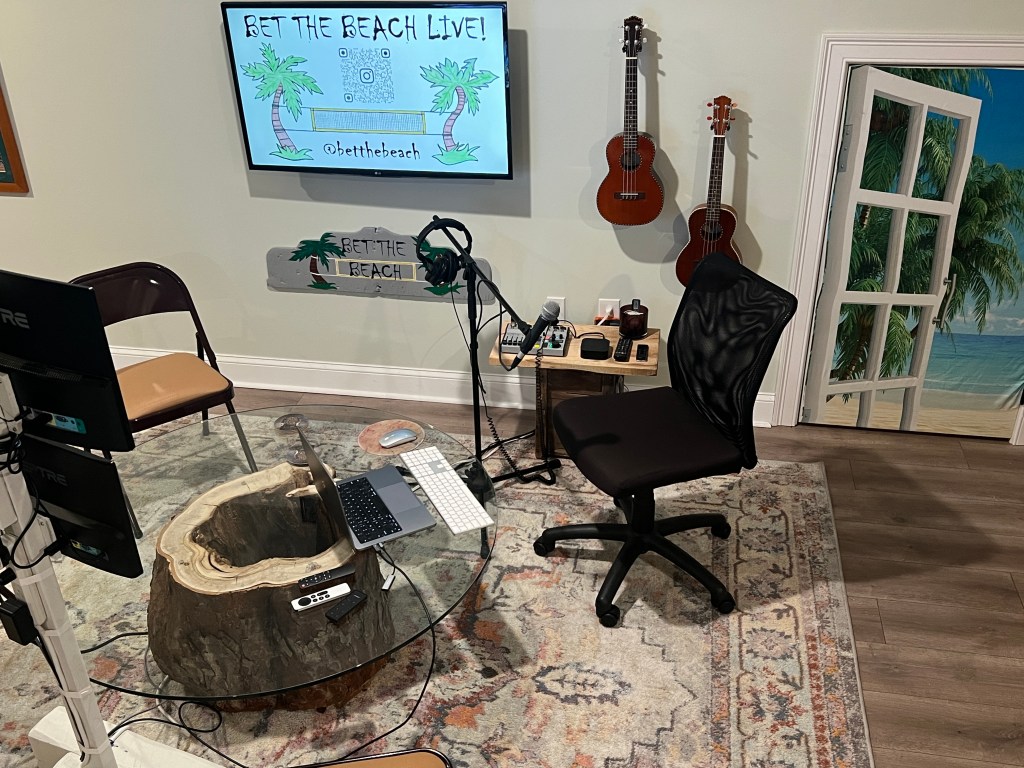
(Artist’s rendering of what a potential Bet The Beach Redzone Studio might look like, theoretically, if it existed, which it doesn’t, probably.)
What would we call it? I know Travis thought the 35 point side switch was the spot, but I’m thinking the 28 point switch might give you more. 14-14, 15-13, 16-12, I think the game really changes there. ”The 28 Switch,” something like that. What you you think?
I know I like the idea. Trav and Tri were interested, what about you?
Chris DeTurk- January 16, 2024
 Bet The Beach
Leave a comment